Thursday, March 19, 1863
Private James T. Akers, from Fuller's Point, and assigned to Company G, died today in Memphis.

Wednesday, March 18, 1863
Two more soldiers from the 130th Illinois Infantry died today. They were both from Company C and from Cairo: Private Frederick Myers died in Memphis, and Private Benjamin Wilson died in St. Louis.
Today, Admiral Porter felt great progress had been made and began to believe this expedition would be successful. However, the Confederates had learned of the expedition and remained a step ahead of them. They sent a brigade of infantry, with several pieces of artillery, to head off the expedition. A gun battery was planted along the route, and an attempt was made to get in the rear of Porter, with the hopes of cutting off his retreat and capturing his gunboats.
Today, Admiral Porter felt great progress had been made and began to believe this expedition would be successful. However, the Confederates had learned of the expedition and remained a step ahead of them. They sent a brigade of infantry, with several pieces of artillery, to head off the expedition. A gun battery was planted along the route, and an attempt was made to get in the rear of Porter, with the hopes of cutting off his retreat and capturing his gunboats.
Monday, March 16, 1863
Andrew Redding, a Private in Company E from Old Ripley, died today in Memphis.
While Ross and Quimby were working their way back to the Mississippi, Grant was informed that Loring was being reinforced from Vicksburg. Fearing the Union expedition be surrounded and captured, Grant planned an expedition to relieve him and at the same time reach the Yazoo above Haynes' bluff.
The route selected was up the Yazoo and through a variety of sloughs, bayous, and backwaters. Rear Admiral Porter, with the Pittsburg, Louisville, Mound City, Cincinnati and Carondelet, four mortar boats and two tugs, accompanied by General Sherman, with one division of his corps, started up the Yazoo today, preceded by the 8th Missouri troops who were to remove trees and other obstructions from the water.
While Ross and Quimby were working their way back to the Mississippi, Grant was informed that Loring was being reinforced from Vicksburg. Fearing the Union expedition be surrounded and captured, Grant planned an expedition to relieve him and at the same time reach the Yazoo above Haynes' bluff.
The route selected was up the Yazoo and through a variety of sloughs, bayous, and backwaters. Rear Admiral Porter, with the Pittsburg, Louisville, Mound City, Cincinnati and Carondelet, four mortar boats and two tugs, accompanied by General Sherman, with one division of his corps, started up the Yazoo today, preceded by the 8th Missouri troops who were to remove trees and other obstructions from the water.
Sunday, March 15, 1863
The Mississippi Flotilla was an important part of the army's campaign on Vicksburg. The fleet was under the command of Rear Admiral David D. Porter.
The flotilla included his flag ship Benton; the gunboat Essex; the ironclads DeKalb, Cairo, Carondelet, Cincinnati, Louisville, Mound City, Pittsburg, Choctaw, Lafayette, Chillicothe, Indianola and Tuscumbia; the Rodgers gunboats Conestoga, Lexington and Tyler; the Ellet rams Fulton, Horner, Lancaster, Lioness, Mingo, Monarch, Queen of the West, Sampson and Switzerland; the tinclads Brilliant, Cricket, Forest Rose, Glide, Juliet, Linden, Marmora, Petrel, Rattler, Romeo and Signal; the mortar boats Abraham, Clara Dolsen, Gen. Lyon, Grampus, Great Western, Judge Torrence, New National and Red Rover, and the dispatch boat William H. Brown.
Over the last two days, a large number of boats belonging to the West Gulf Squadron commanded by Rear Admiral David G. Farragut, passed the batteries at Port Hudson, Louisiana and steamed north to take part in the Vicksburg campaign.
These included the flagship, Hartford, and Mississippi, Monongahela, Richmond, Genesee, Kineo, Albatross, Estrella and Arizona. Also several various gunboats participated in some of the operations, including Alexandria, Argosy, Black Hawk, Champion, Covington, Curlew, Hastings, Exchange, Key West, Kenwood, Moose, New Era, Naumkeag, Pawpaw, Peosta, Prairie Bird, Queen City, Reindeer, St Clair, Silver Cloud, Silver Lake, Springfield, Tawah and Victory.
The flotilla included his flag ship Benton; the gunboat Essex; the ironclads DeKalb, Cairo, Carondelet, Cincinnati, Louisville, Mound City, Pittsburg, Choctaw, Lafayette, Chillicothe, Indianola and Tuscumbia; the Rodgers gunboats Conestoga, Lexington and Tyler; the Ellet rams Fulton, Horner, Lancaster, Lioness, Mingo, Monarch, Queen of the West, Sampson and Switzerland; the tinclads Brilliant, Cricket, Forest Rose, Glide, Juliet, Linden, Marmora, Petrel, Rattler, Romeo and Signal; the mortar boats Abraham, Clara Dolsen, Gen. Lyon, Grampus, Great Western, Judge Torrence, New National and Red Rover, and the dispatch boat William H. Brown.
Over the last two days, a large number of boats belonging to the West Gulf Squadron commanded by Rear Admiral David G. Farragut, passed the batteries at Port Hudson, Louisiana and steamed north to take part in the Vicksburg campaign.
These included the flagship, Hartford, and Mississippi, Monongahela, Richmond, Genesee, Kineo, Albatross, Estrella and Arizona. Also several various gunboats participated in some of the operations, including Alexandria, Argosy, Black Hawk, Champion, Covington, Curlew, Hastings, Exchange, Key West, Kenwood, Moose, New Era, Naumkeag, Pawpaw, Peosta, Prairie Bird, Queen City, Reindeer, St Clair, Silver Cloud, Silver Lake, Springfield, Tawah and Victory.
Saturday, March 14, 1863
Quimby began a short bombardment of Fort Pemberton, but again, there was little damage. Quimby decided to send for a pontoon bridge, hoping he could cross the Yallabusha River and gain an advantage behind the rear of the fort. But before the movement could be executed Grant ordered the entire force to return to the Mississippi River.
Friday, March 13, 1863
Confederate spies kept General Pemberton well informed of every movement Grant made. When it became obvious the Union army was preparing to advance by the Yazoo, the Confederates took steps to slow them down. Yazoo pass, as well as the Coldwater River, ran through a forest. The Confederate army cut down a large number of trees, letting them fall into the water. This greatly slowed the advance of the Union boats, as the obstructions had to first be removed.
After testing the pass with some advanced troops, Grant ordered General McPherson to move his whole corps, about 30,000 men, down to Yazoo City, while two divisions of cavalry moved to the east to cut the Confederate's communications.
In the meantime, Confederate General Pemberton sent General Loring, with about 2,000 men and 8 heavy guns to the mouth of the Yallabusha to halt the Union passage of the Yazoo. About 5 miles below the mouth of the Yallabusha River, the waters of the Yazoo and Tallahatchie are within a short distance of each other because of a sharp bend. Here Loring constructed a line of works, and called it Fort Pemberton.
The obstructions encountered by the Union troops gave Loring plenty of time to construct the fort and make preparations. When the Union gunboats and transports arrived before the fort on March 11, 1863, they found the Confederates well prepared for battle. The ground in front of the fort was filled with water, and so a troop assault was out of the question. The only thing the Union gunboats could do was to fire on the Confederate's guns.
Yesterday the Union army established a land battery about 800 yards from the fort, and today the bombardment continued. However, the union could do no damage to the fort. Seeing no other options, General Ross moved his troops buck up the river until he met General Quinmby's division. Quinby, being the senior officer, assumed command and ordered the whole expedition back to Fort Pemberton.
Thursday, March 12, 1863
After the failure of the Williams Canal, attention was turned to the Lake Providence route. This route had been examined by engineers and thought to be practical. The canal would be completed on March 16th, connecting Lake Providence with the Mississippi River. But Grant would never use this route.
Grant believed the route via the Yazoo pass, the Coldwater and the Tallahatchie rivers was the best of the two remaining options. This route would allow Grant to gain the high ground on the Yazoo above Haines Bluff.
Yazoo pass was a bayou, connecting the Mississippi, through Moon Lake, with the Coldwater River. In earlier times it had been used by boats from Memphis to Yazoo City, but before the beginning of the war it had been closed by a strong levee to reclaim a large tract of land that frequently flooded.
This route had been under consideration for some time. Even before the failure of the Williams Canal, on February 3, 1863, the levee was blown up by a mine. Four days later, on February 7th a Union gunboat entered the pass.
Grant believed the route via the Yazoo pass, the Coldwater and the Tallahatchie rivers was the best of the two remaining options. This route would allow Grant to gain the high ground on the Yazoo above Haines Bluff.
Yazoo pass was a bayou, connecting the Mississippi, through Moon Lake, with the Coldwater River. In earlier times it had been used by boats from Memphis to Yazoo City, but before the beginning of the war it had been closed by a strong levee to reclaim a large tract of land that frequently flooded.
This route had been under consideration for some time. Even before the failure of the Williams Canal, on February 3, 1863, the levee was blown up by a mine. Four days later, on February 7th a Union gunboat entered the pass.
Wednesday, March 11, 1863
George F. Curry, a Private in Company G, from Fuller’s Point, died in Memphis today.
Tuesday, March 10, 1863
All of this activity marked the start of the Vicksburg campaign. At the beginning of the campaign there were about 43,000 men in the Union ranks. In a little over two months General Grant's army will swell to 75,000 men around Vicksbug.
The strength of the Confederate forces at the beginning of the Vicksburg campaign was estimated to be between 40,000 to 60,000 men. By the time Vicksburg surrendered, there was just over 31,000 Confederate soldiers.
Sunday, March 8, 1863

General Sherman's defeat at the battle of Chickasaw Bluffs in late December demonstrated the strength of the Confederate position on the north side of Vicksburg. General Grant then decided the best strategy was to gain a foothold below the city and attack from the south.
To do this it would be necessary to transport the army and its supplies to some point down the river. The Queen of the West ran past the batteries in front of Vicksburg on the night of February 2nd, and the Indianola on the night of February 13th. Although these single vessels had passed safely, it was considered far too hazardous to attempt the passage of a large number of transports loaded with men and supplies. So, a channel for the boats was sought elsewhere.
Three routes were considered. The first was the canal that had been excavated by General Williams across the southern part of the peninsula opposite Vicksburg in June of 1862. The second was to connect Lake Providence near the Arkansas line, with the Mississippi by a canal about a mile long and send the fleet through Louisiana via the Tensas, Black and Red rivers to a point on the Mississippi below Natchez. The third option was the Yazoo pass route on the eastern side of the river.
Work was commenced on the Williams canal early in February of 1863. The plan was to change the course of the original canal to insure a better current. The work preceded vigorously, despite the rainy weather that had set in. Unfortunately, on March 7, 1863, (yesterday) just as the canal was almost completed, the levee gave way, flooding the canal and the camps to the west of it.
The Williams canal was no longer an option.
Saturday, March 7, 1863
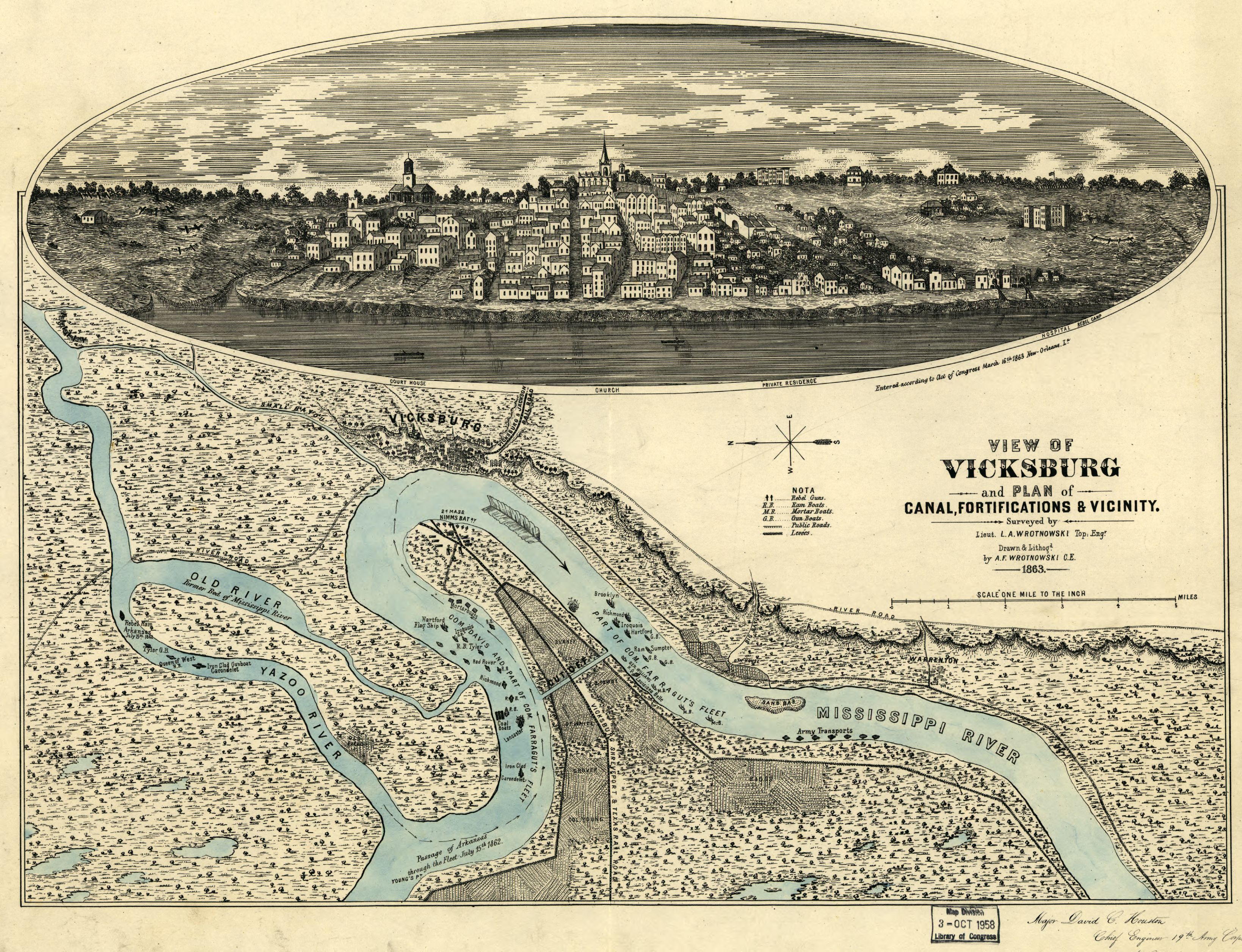
Vicksburg was called the Gibraltar of the West. Still today, the town rises sharply about 200 feet up the eastern bluff of the Mississippi. The west side of the river is low bottom land. Directly opposite Vicksburg is a long, narrow peninsula, formed by an abrupt horseshoe bend in the river just north of the city. This gave the Vicksburg batteries the chance to see their targets coming well before they fired down upon them.
At the bend the bluffs turn away from the river into a range called the Walnut Hills, leaving another bottom land through which the Yazoo river and numerous bayous flow. About seven miles below Vicksburg, the bluffs again recede from the river at Warrenton.
This terrain made Vicksburg a location that was easily defensible. It was protected on three sides by the river and its low bottoms. A line of troops from the Warrenton ridge on the south to the Walnut hills on the north, was all that was needed to guard against an attack from the east.
Additionally, the plateau formed by the bluffs was full of deep ravines, which made it extremely difficult to maneuver troops.
At this time Vicksburg was the last remaining Confederate stronghold on the Mississippi River. In order for the Union Army to freely use the Mississippi for transportation of troops and supplies, the capture of Vicksburg was essential.
Friday, March 6, 1863
Yet another soldier from the 130th died today. Private William W. Brown, assigned to Company E, died today. He was from Pochahontas.
Thursday March 5, 1863
Garrison duty in Memphis also allowed the men of the 130th to attend church services. Their presence in the local churches was probably accepted by some. However, it's likely that many local residents resented the attendance by the "northern aggressors."
Charles Johnson had this to say:
I remember frequent attendance at an Episcopal Church in the city. The pastor had but one eye, and was a very plain man in appearance, but was an able preacher, Here I first saw General J. B. McPherson. His division was at the time encamped near the city, and he improved the opportunity for attendance at a church which is said to be a favorite denomination with regular army officers. His handsome person, graceful carriage and affable manners are well remembered.
Wednesday, March 4, 1863
Private Walter Wilbern from Selbysport,
Maryland, died today at Memphis. He was assigned to Company G.
Tuesday, March 3, 1863
Private Josiah L. Livingston from Hutten died today in Memphis. He was assigned to Company G.
Sunday, March 1, 1863
The 130th Illinois Infantry started off the new month with another desertion. Private Charles Vandervest, Company H, from Claremont, was listed as deserted today.
Wednesday, February 25, 1863
Garrison duty in Memphis gave the soldiers from the 130th Illinois Infantry an opportunity to enjoy the city. As the beautiful spring weather continued to improve, the Illinoisans would spend their leisure time taking enjoyable walks throughout the city.
Charles Johnson described one of his favorite Memphis destinations:
Nowhere was the soft spring air more pleasure-giving than in a little park near the business part of the city, name forgotten. In this was a statue of General Jackson, having engraved upon the marble pedestal the hero's well-known words: "The Federal Union it must and shall be preserved!" This patriotic sentiment was too much for the eyes of some miserable vandal, and the word "Federal" had been obliterated with a chisel or other sharp tool.
From the Wisconsin Historical Society (http://www.wisconsinhistory.org/diary/003890.asp) we can learn more about the Monument of Jackson:
Andrew Jackson, President of the United States from 1829 to 1837, was one of the founders of Memphis in 1819. To commemorate him, the citizens of Memphis erected a marble bust in 1859 which bore the words, "The federal union: It must and shall be preserved" on its pedestal. Jackson uttered the phrase during the Nullification Crisis of 1828-1832, when South Carolina declared any state's right to nullify federal laws that ran contrary to its interest. President Jackson firmly opposed this view and threatened to send troops to South Carolina to ensure that federal law prevailed. He spoke these words as a toast during the Democratic Party's Jefferson Day dinner in 1830 and they were later engraved on the pedestal of his statue. The monument became an unintentional symbol of Union sentiment after the city's occupation in July 1862, and a Confederate sympathizer had gained national notoriety for trying to chip away the offensive quote.
Charles Johnson described one of his favorite Memphis destinations:
Nowhere was the soft spring air more pleasure-giving than in a little park near the business part of the city, name forgotten. In this was a statue of General Jackson, having engraved upon the marble pedestal the hero's well-known words: "The Federal Union it must and shall be preserved!" This patriotic sentiment was too much for the eyes of some miserable vandal, and the word "Federal" had been obliterated with a chisel or other sharp tool.
From the Wisconsin Historical Society (http://www.wisconsinhistory.org/diary/003890.asp) we can learn more about the Monument of Jackson:
Andrew Jackson, President of the United States from 1829 to 1837, was one of the founders of Memphis in 1819. To commemorate him, the citizens of Memphis erected a marble bust in 1859 which bore the words, "The federal union: It must and shall be preserved" on its pedestal. Jackson uttered the phrase during the Nullification Crisis of 1828-1832, when South Carolina declared any state's right to nullify federal laws that ran contrary to its interest. President Jackson firmly opposed this view and threatened to send troops to South Carolina to ensure that federal law prevailed. He spoke these words as a toast during the Democratic Party's Jefferson Day dinner in 1830 and they were later engraved on the pedestal of his statue. The monument became an unintentional symbol of Union sentiment after the city's occupation in July 1862, and a Confederate sympathizer had gained national notoriety for trying to chip away the offensive quote.
w775.jpg)
Tuesday, February 24, 1863
Two more soldiers from the 130th Illinois Infantry died today in Memphis: Private William E. Leisure from Blueville was part of Company D; Private Delembert Cully from Cairo was part of Company C.
Monday, February 23, 1863
Private Thomas J. Darden from Sangamon County died today in Memphis. He was assigned to Company B.
Sunday, February 22, 1863
Henry W. Miller, a new recruit assigned to Company E, died today in Memphis. He was from Dudleyville.
Wednesday, February 18, 1863
Private Ephraim Milsaps deserted today. He was from Baden and a member of Company E.
The Company C musician, William M. Jackson died today at Memphis. He was from Cairo.
Tuesday, February 17, 1863
In the middle of February Charles Johnson witnessed the destruction of Hopedale, Arkansas, apparently from the comfort of a rocking chair.
Sitting on the upper front porch one day and looking toward the river, not many rods away, two or three gunboats were seen to approach the little village of Hopedale, just opposite Memphis, on the Arkansas shore; they did not land, but pretty soon turned away and took position in the middle of the river, from which point a number of shells were thrown into the village and soon Hopedale was in flames. It seemed this place had been a sort of rallying point for guerillas, bushwhackers and other irregular Confederate soldiers and to stop their incursions Hopedale had been ordered burned, after, of course, first warning the inhabitants.
Monday, February 16, 1863
Today First Lieutenant William Harlan died. He was from Bond County and part of Company E.
Saturday, February 14, 1863
Corporal Anderson Kenard, Company H, from Mt. Carmel, died today at Memphis.
Thursday, February 12, 1863
The weather in Memphis began to improve. Charles Johnson described the change:
About the middle of February signs of spring began to show themselves in that genial climate. Grass became green, peach trees blossomed, bees came out and birds came around.
About the middle of February signs of spring began to show themselves in that genial climate. Grass became green, peach trees blossomed, bees came out and birds came around.
Sunday, February 8, 1863
Two more men from the 130th Illinois Infantry died today: Corporal William L. Curry, Company G, from Fuller’s Point; and, Corporal Harlow M. Street, Company F from Pocahontas, who died at Memphis.
Monday, February 2, 1863
Private William Jackson, from Donelson and Company G, died yesterday in Memphis.
Today, Sergeant Jacob A. Cook, Company D, from Blueville, was reported as a deserter.
Subscribe to:
Posts (Atom)